Patient Portal
 Online Payment
 Doctor Referral
 Financing


Cataracts are one of the most common vision changes that come with age, but deciding when to have cataract surgery is different for every patient. At St. Michael’s Eye & Laser Institute in Largo, Florida, John Michaelos, MD, and our eye care team regularly meet with patients who know they have cataracts but are not sure whether it is time to do something about them.
The answer usually comes down to one simple question: Are cataracts beginning to interfere with the things you want or need to do every day?
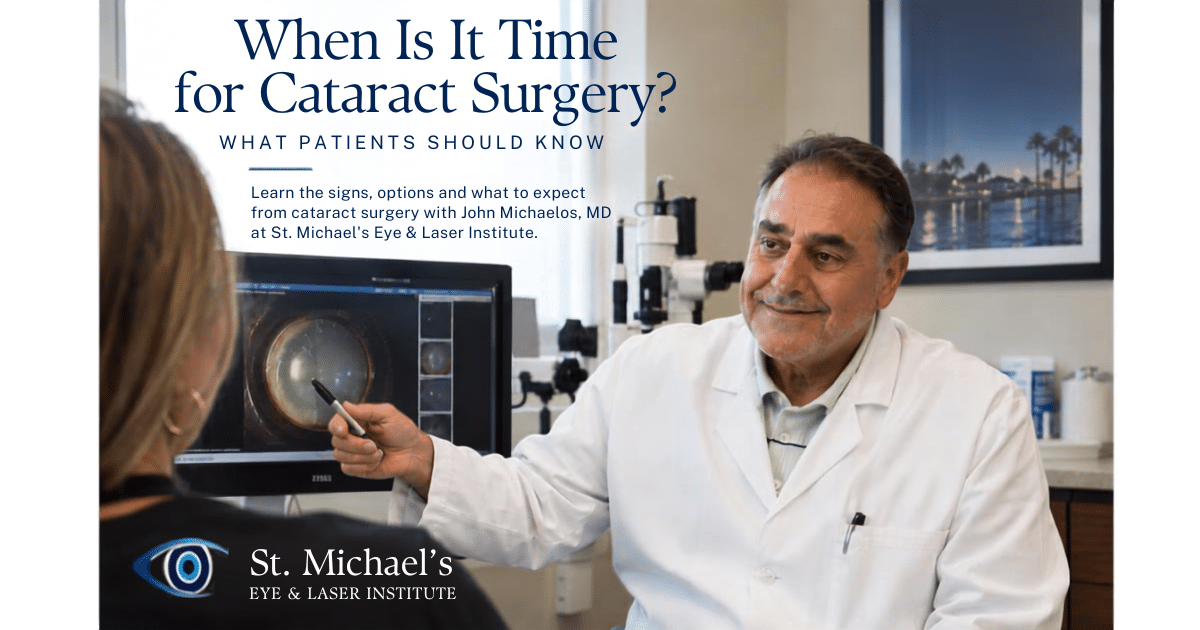
What Is a Cataract?
Inside the eye is a natural lens that helps focus light so you can see clearly. Over time, that lens can become cloudy. This clouding is called a cataract.
Cataracts generally develop gradually, which means patients may adapt to changes in their vision without realizing how much clarity they have lost.
Common symptoms can include:
- Blurry or hazy vision
- Increased glare from headlights
- Halos around lights
- Difficulty seeing at night
- Colors appearing dull or faded
- Frequent changes in glasses prescriptions
- Needing brighter light to read
- Difficulty recognizing faces or seeing details at a distance
For many patients, nighttime driving is one of the first situations where cataracts become especially noticeable.
You Do Not Have to Wait Until a Cataract Is “Ripe”
Years ago, patients were sometimes told to wait until a cataract became advanced before having surgery. Modern cataract surgery has changed that approach.
Today, the decision is usually based on how much the cataract is affecting a patient’s vision and quality of life.
John Michaelos, MD, evaluates each patient individually at St. Michael’s Eye & Laser Institute. Someone who drives frequently at night, works on a computer, plays golf, reads extensively, or has other specific visual needs may notice the impact of a cataract sooner than someone with a different lifestyle.
There is no single vision measurement that determines the right time for every person.
What Happens During a Cataract Evaluation?
A cataract consultation involves much more than simply determining whether a cataract is present.
Your eye doctor will evaluate your vision, the health of the eye and the severity of the cataract. Measurements of the eye are also important when cataract surgery is being considered because the cloudy natural lens is replaced with an artificial intraocular lens, commonly called an IOL.
At St. Michael’s Eye & Laser Institute, the goal is to understand both the health of the eye and the patient’s visual priorities before developing a treatment plan.
Questions may include:
- What activities are becoming harder?
- Do you drive frequently at night?
- Do you rely heavily on reading or computer vision?
- How important is reducing dependence on glasses?
- Do you have other eye conditions that could affect your final vision?
Those answers help guide the conversation about surgery and lens options.
Cataract Surgery Has Become Highly Customized
One of the biggest changes in modern cataract care is the ability to customize treatment around the individual patient.
Traditional cataract surgery can restore vision by replacing the cloudy natural lens with a clear artificial lens. Depending on the patient’s eyes and goals, additional technology and lens options may also be available to address astigmatism or provide a broader range of vision.
Not every lens or technology is appropriate for every eye.
That is why John Michaelos, MD, emphasizes evaluating the entire eye before recommending a particular cataract treatment plan. The best option is the one that fits the patient’s eye health, lifestyle and expectations.
Don’t Ignore Gradual Changes in Vision
Because cataracts usually progress slowly, it can be surprisingly easy to underestimate how much they are affecting everyday life.
Patients sometimes realize after treatment that they had gradually stopped driving at night, avoided certain roads, increased the brightness on every device, stopped reading small print or relied increasingly on family members because their vision had changed.
If your vision feels different than it did a year ago, an eye examination can help determine why.
Cataracts are only one possible cause. Changes in prescription, dry eye, glaucoma, retinal disease and other eye conditions can also affect the quality of vision.
Eye Care in Largo and the Tampa Bay Area
St. Michael’s Eye & Laser Institute has cared for generations of patients throughout Largo, Clearwater and the greater Tampa Bay area.
John Michaelos, MD, provides comprehensive ophthalmic care with an emphasis on evaluating each patient’s individual visual needs before recommending treatment.
If cataracts are beginning to interfere with driving, reading, work or the activities you enjoy, you do not have to wait for your vision to become significantly worse before having them evaluated.
Schedule a comprehensive eye examination with St. Michael’s Eye & Laser Institute and find out whether cataracts or another vision change may be affecting the way you see.
Clear Vision. Brighter Lives.