Patient Portal
 Online Payment
 Doctor Referral
 Financing


LASIK For Largo, Clearwater & St. Petersburg, FL
LASIK corrects nearsightedness, farsightedness and astigmatism, and it can free you from dependence on glasses and contacts. The FDA approved the first laser for LASIK in 1998, and millions of Americans have had it since.
At St. Michael’s Eye & Laser Institute in Largo, our LASIK technology is among the most advanced available, and our physicians are among the most trusted in the Tampa Bay area. It’s little wonder so many patients choose us for LASIK.
Wondering if LASIK is right for you? Start with the basics below, or take our LASIK Self-Test.
Patient Education Video
How LASIK works
How is LASIK performed?
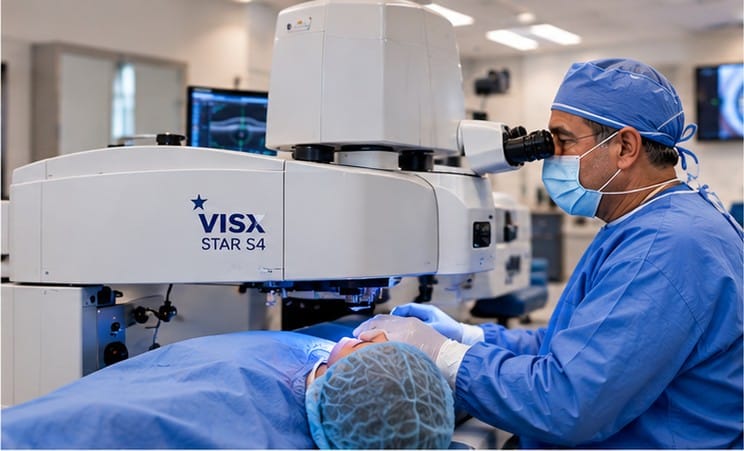
LASIK stands for laser-assisted in situ keratomileusis. A highly specialized laser reshapes your cornea, the clear dome over the iris and pupil, so light entering your eye focuses properly on the retina. It changes how your eye focuses the same way glasses and contacts do, without the glasses and contacts.
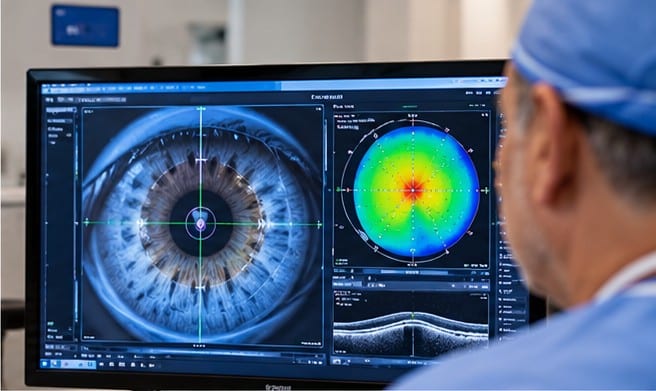
Your cornea works with the lens inside your eye like a camera, focusing incoming light onto the retina at the back of the eye. When the cornea is misshapen, light doesn’t land where it should and your vision blurs. LASIK corrects the shape with a computer-guided laser programmed with precise measurements of your eyes. The result is markedly improved vision, and many patients achieve 20/15 vision or better.
What can LASIK correct?
LASIK treats the three most common refractive errors.
Nearsightedness
Myopia
Distant objects look blurry while things up close stay clear.
Learn about nearsightedness →Farsightedness
Hyperopia
Close-up objects are harder to bring into focus than distant ones.
Learn about farsightedness →Astigmatism
Irregular corneal curve
An unevenly curved cornea blurs or distorts vision at every distance.
Learn about astigmatism →What LASIK won’t fix: presbyopia. Presbyopia is the age-related loss of near vision that happens as the natural lens inside your eye hardens and stiffens, making it hard to read text up close. LASIK reshapes the cornea, so it doesn’t address presbyopia. Learn about presbyopia →
The LASIK process
What should you expect from LASIK surgery?
From your first visit to clear vision, here’s how it goes.
-
1
Free consultation
Talk through your goals with our team and find out if LASIK is a good fit for your eyes and your lifestyle.
-
2
Comprehensive refractive workup
Our ophthalmologists thoroughly test your vision to get the precise measurements the computer-guided laser uses.
-
3
Procedure day
LASIK takes only about 20 minutes for both eyes. Most patients notice improved vision, without glasses or contacts, right after.
-
4
Recovery
Most patients are back to their routine the day after LASIK and driving within a week. Vision keeps sharpening over the next three to six months.
Before
Preparing for LASIK
- Stop wearing contact lenses at least five days before, and possibly up to two weeks. Contacts change the shape of your cornea, and exact measurements are crucial.
- Wear toric lenses for astigmatism? Plan on 10 to 14 days without them.
- Drink plenty of water.
- Line up a ride to and from your procedure. Your vision will be blurry.
- Skip makeup on surgery day. It can interfere with the sterile surgical environment and the medications and lasers used.
- Leave off perfume, cologne and scented products. Our surgical suite is regulated for precise temperature, purity and humidity.
After
LASIK eye surgery recovery
- An itchy or burning feeling right after LASIK is normal.
- Rest your eyes for the first couple of hours and avoid strenuous activity.
- Use your prescribed eye drops exactly as directed. They help prevent infection and protect the healing flap.
- Wear UV-protective sunglasses during the day and eye shields when you sleep.
- Don’t rub or touch your eyes for the first month.
- Keep soap and chemicals out of your eyes, and stay out of hot tubs, pools, lakes and oceans until we clear you.
- Skip eye makeup and contact sports until we clear you.
- Make every follow-up visit so we can confirm your eyes are healing well.
Safety
Is LASIK safe?
The complication rate for LASIK is extremely low, making it one of the safest surgical procedures. The procedure itself is pain free. You may feel a temporary burning or itching sensation afterward, and your doctor will likely have you use eye drops for a period of time to reduce inflammation and keep your recovery smooth.
Another option
What is Epi-LASIK?
Epi-LASIK is an advanced surface treatment that doesn’t require a traditional LASIK flap. We offer it to some patients who aren’t good candidates for LASIK, such as people with thinner corneas. Recovery usually takes longer than LASIK because the surface of the cornea needs time to heal.
Learn about Epi-LASIK →
Why people choose LASIK
LASIK benefits
Freedom from glasses and contacts
The biggest benefit of all. Wake up and see clearly without reaching for corrective eyewear.
Lasting results
LASIK permanently reshapes your cornea for long-term vision improvement and a better quality of life.
Savings over time
No more buying contacts, solution and new glasses every year.
Try the savings calculator →Fewer contact lens risks
No more touching your eyes every day or risking a corneal infection from sleeping in your contacts.
LASIK pricing
How much does LASIK cost?
Straightforward pricing with no vague ranges. You can pay with CareCredit financing or pre-tax FSA and HSA dollars.
$1,500 per eye
$3,000 for both eyes
- Free consultation
- $500 workup, refunded if you’re not a candidate
- Touch-ups included with annual exams
- 20% off for military and first responders
Why St. Michael’s
Why choose St. Michael’s Eye & Laser Institute?
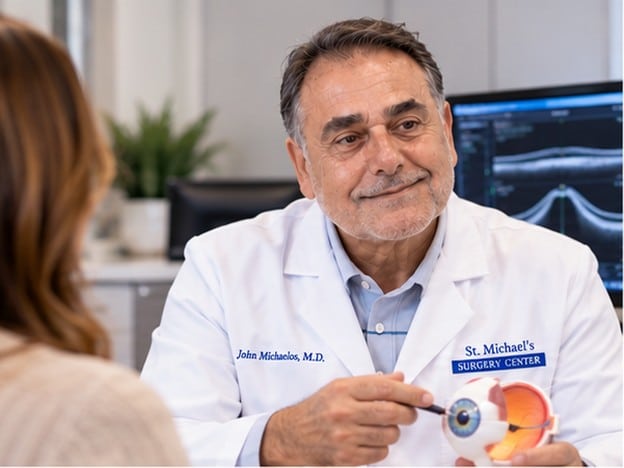
With any surgery, the surgeon’s skill and experience are critical to getting the best results. Ours runs deep.
- Fellowship-trained in corneal disease Dr. Michaelos completed fellowship training in corneal and external diseases at the University of South Florida. LASIK reshapes the cornea, so that training matters.
- Decades of surgical experience He is one of Tampa Bay’s most experienced ophthalmologists and has served as an associate professor of ophthalmology.
- Alcon Center of Excellence Our practice is recognized by Alcon as an Alcon Center of Excellence.
- Trusted since 1961 Individualized, compassionate care and a welcoming environment at every visit, for more than 60 years.

 Center of Excellence
 Best of Florida 2026
 Member
 Member




Not sure if you’re a candidate?
Take our quick LASIK Self-Test, or book a free consultation and get a straight answer. Am I a candidate for LASIK? →
Book Your Free LASIK Consultation
Make sure Lasik Consult is selected as your visit reason. Rather talk to someone? Call (727) 202-2020.
Who performs LASIK at St. Michael’s
Laser vision correction at St. Michael’s Eye & Laser Institute in Largo, Florida, including LASIK and PRK, is performed by Dr. John Michaelos, our medical director, who completed fellowship training in corneal disease. Dr. Luis Ortiz, OD, who trained in refractive surgery co-management, helps with exams before and after treatment.