Patient Portal
 Online Payment
 Doctor Referral
 Financing

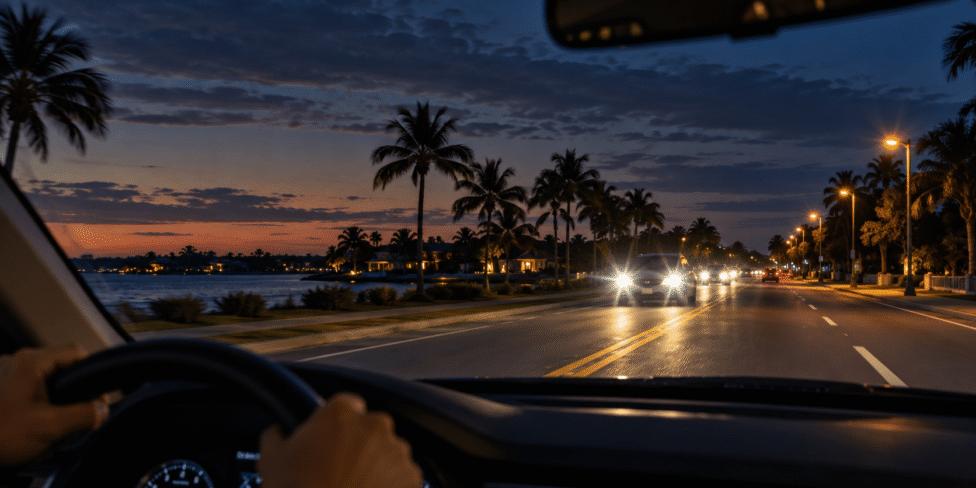
The clocks fall back on November 1, and the evening commute in Pinellas County goes from daylight to headlights almost overnight. Every October we start hearing the same thing from patients: night driving has gotten harder, and they are not sure whether that is the eyes or just the roads.
Usually it is the eyes, and usually it is fixable. Glare, halos and starbursts around oncoming headlights are not a normal part of getting older that you are stuck with. They are a symptom, and there are only a handful of things that cause them.
What patients actually describe
People rarely walk in and say they have glare. They say oncoming headlights smear into a star shape, or streetlights have rings around them. They say road signs are readable in daylight but washed out at night, or that rain at night is suddenly much worse than it used to be. Some have quietly stopped driving after dark, which is often the detail that brings a spouse to the appointment.
All of these come down to the same physical problem. Light entering the eye is scattering instead of focusing cleanly on the retina. At night your pupil opens wider to let in more light, which means more of the eye is being used, so any imperfection in the tear film, the cornea or the lens has a bigger effect than it does in daylight. This is why someone can see 20/20 on an eye chart in a bright room and still struggle on Ulmerton Road at 7 p.m.
Cataract is the most common explanation after 55
A cataract is a clouding of the eye’s natural lens, and it scatters light before it ever reaches the retina. Night glare is often the very first thing people notice, well before they notice any blur. Daytime vision can still measure well while headlights have become genuinely difficult.
Cataracts develop slowly, which is why people blame the headlights, the windshield or the brightness of modern LEDs rather than their eyes. Florida does not help, since a lifetime of sun exposure contributes. If glare at night is your main complaint and you are over 55, a dilated exam is the way to find out. Our cataract surgery page covers how cataracts are treated.
Dry eye is the one people least expect
The front surface of your eye is covered by a tear film, and that film is the first lens light passes through. When it is uneven, light scatters. Patients are often surprised that an eye that does not feel dry can still have an unstable tear film, and that this alone can cause real night glare.
Long drives make it worse for a mechanical reason. You blink less when you concentrate, and the air conditioning or defroster blowing across the dashboard dries the surface further. If your vision clears for a second or two right after you blink and then degrades again, that is a strong hint that the tear film is involved. Dry eye is also the most treatable item on this list.
Glasses, corneas and a few other causes
Several other things produce the same complaint, and they are worth ruling in or out at an exam rather than guessing:
- An out-of-date prescription, especially an uncorrected astigmatism, which stretches points of light into streaks that get worse as the pupil widens.
- Scratched lenses or glasses with no anti-reflective coating, which add their own reflections.
- Corneal surface irregularity from scarring, keratoconus, a dystrophy or previous laser vision correction. Our cornea center handles these.
- A clouded membrane behind a lens implant, which can develop years after otherwise successful cataract surgery and is corrected with a brief in-office laser procedure.
- Macular degeneration, which does not usually cause glare but does slow how quickly your eyes adapt when you move from a lit area into the dark.
- Glaucoma, which affects peripheral and low-light vision and can make night driving feel harder without any glare at all.
What helps, and what does not
Keep the inside of your windshield clean, since haze and film on the glass scatter light just like a cataract does. Aim your gaze at the right edge of your lane rather than at oncoming headlights. Dim your dashboard. If you wear glasses, ask about an anti-reflective coating, which makes a measurable difference and costs little.
What does not help is the yellow-tinted night driving glasses sold at pharmacies and online. They reduce the total amount of light reaching your eye, which is the opposite of what you need after dark, and they do not fix the scatter that is causing the problem. If glare is bad enough that you are shopping for a product to solve it, the better move is an exam.
Frequently asked questions
Is night glare always a cataract?
No. Dry eye and an outdated prescription are both common causes, and in younger patients they are more likely than cataract. Those are also the easiest to fix, which is a good reason to get checked rather than assume the worst.
I had cataract surgery years ago. Why is glare back?
Two possibilities come up most often. A thin membrane behind the lens implant can cloud over time, which is treatable in the office in a few minutes. Dry eye can also develop or worsen in the years after surgery. Either way it is worth an exam, because this is not something you have to live with.
Should I just stop driving at night?
Not before finding out why. Giving up night driving is a real loss of independence, and in most cases the cause is treatable. If you have already cut back, say so at your appointment, because it tells us how much the vision is actually affecting your life.
Get it checked before the time change
If glare at night has been creeping up on you, the next few weeks are a good time to have it looked at. A dilated eye exam can usually sort out which cause is responsible in a single visit, including the testing of the cornea, lens and retina the answer depends on.
St. Michael’s Eye & Laser Institute has been independent and family-owned in Largo since 1961, and exams, testing, surgery and follow-up care all happen in one building. If treatment turns out to be the answer, the doctor who examines you is the one who takes care of it.
Book an appointment online or call (727) 202-2020. Tell the scheduler that night glare is your main concern, so we set aside time for a dilated exam.