Patient Portal
 Online Payment
 Doctor Referral
 Financing

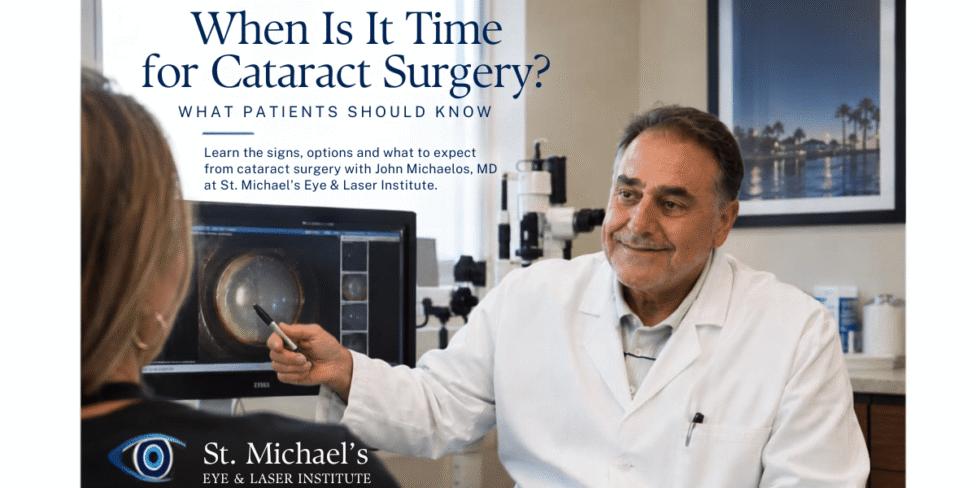
Most people only choose a cataract surgeon once. You have the surgery, and if it goes well you never think about it again. That makes it one of the hardest decisions to research, because you have no experience to compare it with and every practice in Tampa Bay says roughly the same things in its advertising.
Cataract surgery is also one of the most commonly performed operations in the United States, and outcomes are excellent for the overwhelming majority of patients. That is exactly why the differences between practices show up in the details: who operates, where they operate, who sees you afterward, and how clearly the lens choices get explained before you sign anything.
Here are the questions worth asking before you commit, whether you end up at our practice in Largo or somewhere else in Pinellas County.
1. Who is actually performing my surgery?
At larger groups and chains, the surgeon you consult with is not always the surgeon in the operating room. Ask directly: will the doctor I meet today be the one doing my procedure? Get the name. It is a fair question and any practice should answer it without hesitation.
2. How often does this surgeon perform cataract surgery?
Cataract surgery rewards repetition. You do not need a number down to the decimal, but you should get a clear sense of whether this is a routine part of the surgeon’s week or an occasional add-on. Ask how long they have been performing the procedure and how often they do it now.
3. Where will the surgery take place, and is that facility accredited?
Cataract surgery is usually done at an outpatient surgery center rather than a hospital. Ask whether the center is accredited, and by whom. AAAHC and The Joint Commission are the two names you are most likely to hear. Accreditation means an outside body has inspected the facility against published standards.
Also ask how far you will have to travel. Some practices consult in one location and operate 30 or 40 minutes away, which matters on surgery day and at every follow-up. Our AAAHC-accredited surgery center is in the same building as our exam rooms, so the consult, the surgery and the follow-up all happen at one address in Largo.
4. Who sees me at my follow-up visits?
The day after surgery matters. So do the visits over the next month. In some models your follow-up care is handed back to an outside optometrist you have never met. That is not automatically bad, but you should know the plan in advance rather than discover it at checkout.
5. How are my lens options explained, and who benefits from the upgrade?
Every cataract surgery replaces your clouded natural lens with an artificial lens implant. Standard monofocal lenses are covered by Medicare and most insurance. Premium lenses that correct astigmatism or reduce your need for reading glasses cost extra, out of pocket.
A good consultation walks you through the trade-offs of each option, including the ones that count against the more expensive lens, such as halos around lights at night. A rushed one hands you a price sheet. Ask what happens if you choose the standard lens, and listen to whether the answer sounds like a reasonable option or a disappointment.
6. Is the practice independent, or owned by a larger company?
A growing share of eye care practices in Florida have been acquired by private equity backed groups. That is not a scandal, and plenty of good doctors work in those practices. But ownership does shape how a practice runs: schedule targets, how long appointments last, which lens vendors are used, and whether the person who makes decisions is in the building.
If continuity matters to you, ask who owns the practice and how long the doctors have been there. St. Michael’s has been family owned since 1961 and is not part of a chain.
7. What exactly does the quoted price include?
Ask whether the quote covers the surgeon’s fee, the facility fee, anesthesia, the lens itself, and postoperative visits. Ask what is billed to insurance and what you pay directly. Then ask what could change the number. A practice that answers this clearly in the consultation will usually bill you the same way.
If you are using Medicare, our insurance page lists the plans we accept, and our staff will tell you what your specific plan covers before you schedule.
8. What happens if something does not go as planned?
Complications after cataract surgery are uncommon, but no surgeon has a perfect record and any surgeon who implies otherwise is overselling. The useful question is what the practice does when a patient needs extra attention: who you call after hours, how quickly you can be seen, and whether additional care is handled in-house.
One common and very manageable example is posterior capsule opacification, a haze that can develop months or years after surgery and is cleared with a brief in-office laser treatment. Ask whether that is done where you had surgery.
9. Can you reach a human when you call?
This sounds trivial until you are two days post-op with a question on a Friday afternoon. Call the office before you schedule and notice what happens. How long until someone answers? Can they answer a basic question about your visit, or does everything get routed to a callback?
A reasonable way to compare practices
Consult with more than one if you have the time. Bring this list. Compare the answers, not the brochures. You are choosing a surgeon and a system that will take care of your eyes for the next several weeks, and, if anything comes up later, for years after that.
- Who is my surgeon, by name?
- How often do they perform this procedure?
- Where is surgery done and is it accredited?
- Who handles my follow-up visits?
- What are my lens options, and what does each trade off?
- Who owns the practice?
- What does the price include?
- What happens if there is a complication?
- How easy is it to reach the office?
Frequently asked questions
How do I know when it is time for cataract surgery?
Generally when cataracts start interfering with things you want or need to do, such as driving at night, reading, or recognizing faces. Our guide on when it is time for cataract surgery goes through the signs in more detail.
Does it matter if my surgeon is an ophthalmologist or an optometrist?
Cataract surgery is performed by ophthalmologists, who are medical doctors with surgical training. Optometrists provide eye exams, prescriptions and much of routine eye care, and they often participate in preoperative and postoperative visits.
Should I get a second opinion?
If you feel rushed, if the plan is not clear, or if you are being pushed toward an expensive lens you do not understand, a second opinion is reasonable. Cataracts rarely require urgent surgery, so you usually have time to think.
Talk with a cataract surgeon in Largo
St. Michael’s Eye & Laser Institute has cared for Tampa Bay patients since 1961, with an accredited surgery center on site and the same doctors from consultation through recovery. Book a cataract evaluation online or call (727) 202-2020.