Patient Portal
 Online Payment
 Doctor Referral
 Financing

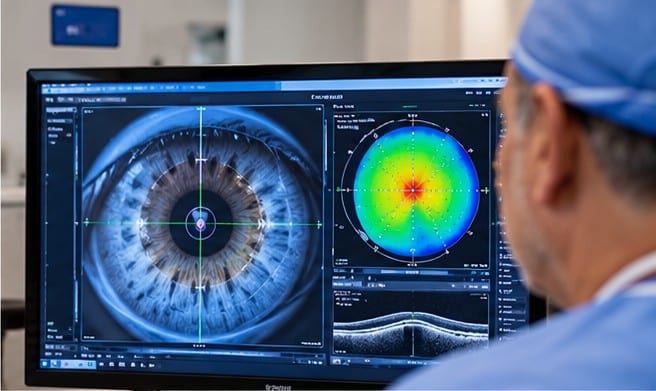
Keratoconus thins and steepens the cornea, changing it from a round dome toward a cone shape. It typically begins in the teens or twenties and can progress for years. Caught early, progression can often be slowed. Caught late, the damage to vision is harder to undo.
Early signs that get missed
- A glasses prescription that changes repeatedly over months
- Increasing astigmatism, often in one eye more than the other
- Ghosting, streaking or multiple images from a single light source
- Glare and halos at night that keep getting worse
- Vision that glasses no longer fully correct
- Frequent eye rubbing, often alongside allergies
Any young adult whose prescription will not settle deserves corneal topography, a quick scan that maps the shape of the cornea and reveals patterns glasses testing alone will not.
Why eye rubbing matters
Vigorous, repeated eye rubbing is strongly associated with keratoconus progression. Patients with allergies rub more, which is one reason treating allergy symptoms is part of the plan rather than an afterthought.
Why timing drives the treatment decision
Corneal cross-linking uses riboflavin and ultraviolet light to strengthen the bonds within the cornea. The goal is to halt progression. It does not reverse thinning that has already happened, which is why it is most valuable early, while vision is still correctable.
Vision correction is a separate question. Glasses work early on. As the cornea steepens, specialty contact lenses often provide sharper vision than glasses can. Advanced cases may eventually require a corneal transplant, which is far less common now than it once was.
What testing involves
A corneal evaluation includes vision testing, refraction, topography or tomography mapping, and measurement of corneal thickness. It is painless and takes one visit. Our cornea center handles diagnosis through treatment.
Frequently asked questions
Is keratoconus hereditary?
There is a familial tendency, so relatives of patients are often screened. Many patients have no family history at all.
Can I have LASIK with keratoconus?
No. Laser vision correction removes corneal tissue and is not appropriate for an already-thinning cornea. Screening for keratoconus is part of every LASIK candidacy evaluation.
Does cross-linking improve my vision?
Its purpose is stability rather than improvement, though some patients see modest changes in corneal shape over time.
Prescription changing too often?
Book an appointment online with St. Michael’s Eye & Laser Institute in Largo, or call (727) 202-2020. We have cared for Tampa Bay families since 1961.