Patient Portal
 Online Payment
 Doctor Referral
 Financing

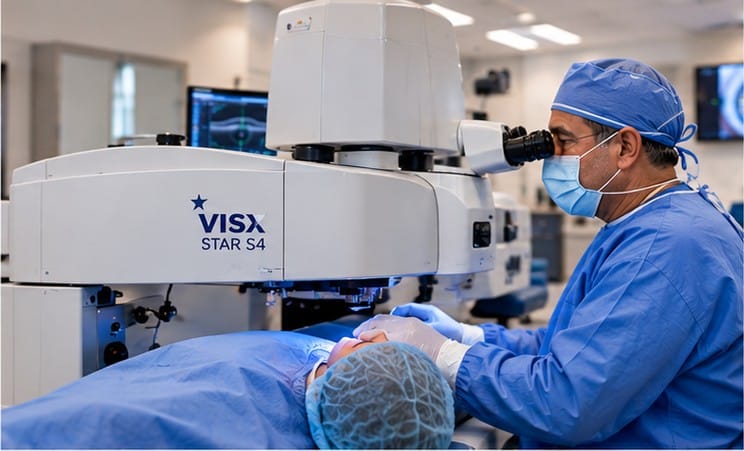
Patients usually arrive asking about LASIK because that is the name they know. LASIK is excellent for the right eyes, but it is one of three main routes to less dependence on glasses, and the best choice depends on your age, your prescription and the structure of your cornea.
LASIK
A thin flap is created in the cornea, the laser reshapes the tissue beneath, and the flap is replaced. Recovery is fast, with most patients seeing well the next day. It suits stable prescriptions in eyes with adequate corneal thickness and a healthy tear film. Our LASIK page covers the procedure in detail.
PRK
PRK reshapes the same tissue without creating a flap. The surface layer is removed and regrows over several days. Final results are comparable to LASIK, but the first week is less comfortable and visual recovery is slower. PRK is often preferred for thinner corneas, for certain corneal surface conditions, and for patients in contact sports or occupations where a flap is a liability.
Refractive lens exchange
Refractive lens exchange replaces the eye’s natural lens with an implant, the same way cataract surgery does, but before a cataract has formed. For patients past roughly 45 to 50, it addresses both distance vision and the loss of reading focus that laser procedures on the cornea cannot fix. It also means a cataract will never develop later.
How the decision usually breaks down
- Twenties to early forties, stable prescription, healthy cornea: LASIK is often first choice
- Thin cornea, irregular surface, or a high-contact job or sport: PRK
- Mid-forties and older, especially with early lens changes or a strong desire to reduce readers: lens-based options
- Any sign of keratoconus: neither LASIK nor PRK, and a corneal evaluation instead
What the evaluation measures
Corneal thickness and shape, pupil size, prescription stability over time, tear film quality, retinal health and your visual demands at work and at home. A free consultation exists to answer this properly, not to talk you into a procedure your eyes are not built for.
Frequently asked questions
Does LASIK hurt?
The procedure itself is not painful thanks to numbing drops. Some scratchiness for a few hours afterward is common.
What if I am told I am not a candidate?
That is useful information, and it usually means another option fits better. Being declined for LASIK by a careful surgeon is better than being approved by a careless one.
How long do the results last?
Corneal procedures are permanent, but aging continues, so reading glasses in your forties and fifties are still likely. Lens-based procedures address that differently.
Find out which one fits your eyes
Book an appointment online with St. Michael’s Eye & Laser Institute in Largo, or call (727) 202-2020. We have cared for Tampa Bay families since 1961.